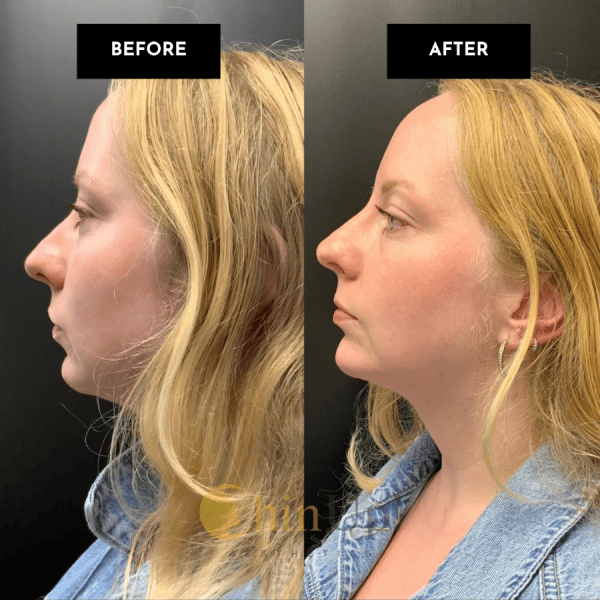

You’ve probably noticed it without being able to name it. Some faces just look balanced. Rested, proportionate, easy to look at. And when you try to work out what changed, you can’t quite put your finger on it.
That’s the whole point of facial balancing. Instead of treating your chin, jaw, cheeks, and lips as four separate requests, your provider plans them together and in a deliberate order. Done well, the change reads as proportion rather than volume, which honestly makes it hard to shop for from a photo!
So this page gives you real before-and-after photos from our own patients, the interval each one was shot at, and the five checks that tell an honest gallery from a flattering camera angle.
Let’s take a look.
What These Photos Really Show
Facial balancing (you’ll also see it called facial harmonization) is a full-face approach that adjusts your proportions instead of treating one feature on its own. In before-and-after photos, the change shows up as a better-defined profile, more even symmetry, and a face that looks rested. Not a face that looks like someone else.
That distinction matters more than anything else on this page. Treat one area on its own, and you make a single feature louder. Plan the whole face, and you make it quieter.
So try not to hunt for the change as you scroll. If you have to look twice to find it, that’s the sign of good work, not the absence of it.
Our Patients’ Results
Every photo below uses the same camera, lens distance, lighting, and neutral expression. No makeup, no filters, no retouching. Each “after” was taken at least four weeks post-treatment, once swelling had resolved, and every case lists its interval. We hold that standard whether the result photographs dramatically or not.
[CASE 1: Chin projection and jawline definition]
A recessed chin pulls your whole lower face out of proportion. It’s the most common reason a profile reads heavier than it actually is. Building chin projection first changes how your jaw, neck, and lips relate to each other, which is why a treatment plan starts here far more often than it ends here.

[CASE 2: Midface support and under-eye shadow]
Hollowing under your eyes is usually a cheek problem more than an eye problem. Restoring support in the midface lifts the tissue that’s casting the shadow. That’s why the under-eye area in this comparison improved without a needle going anywhere near it.

[CASE 3: Profile balance across chin and lips]
Lip proportion gets judged from the side just as much as from the front. Treat the lips without addressing the chin sitting behind them, and you land in the most common trap in injectables: it looks right straight on, and slightly off in profile.

[CASE 4: Correcting facial asymmetry]
Almost every face is asymmetrical, including ours! Perfect mirroring was never the goal here. Conservative dosing on one side brought the two halves close enough that the difference stops pulling your eye.
All photos show actual patients of Chin Up! Aesthetics, published with written consent. Images are unretouched and unfiltered. Individual results vary based on anatomy, product selection, and treatment plan. These photos are not a guarantee of outcome.

How to Read Any Before-and-After Photo
Before you judge any gallery, ours or anyone else’s, run these five checks.
Angle and camera distance
The same face shot from six inches closer looks fuller and better defined with no treatment at all. Compare ear position and how much neck is visible in both frames. If those don’t match, the camera moved, not the face.
Lighting
Overhead light deepens hollows in a “before.” Front light erases them in an “after.” Find the shadows under the cheekbone and along the jaw. If their direction and depth match in both images, the lighting was controlled.
Expression and head tilt
A dropped chin and a slight smile change a jawline more than a syringe does. Use the eyes as your reference point. If the eye line sits at a different height or tilt in the after photo, the head was repositioned, and any apparent definition is unreliable.
Timing
Ask how many weeks passed. Filler attracts water, so the first two weeks show you a face the patient won’t keep. A photo taken at day three shows swelling, not results. Almost nobody thinks to ask, and almost no clinic offers it up. So ask!
Full disclosure
Ask what else was done. A “chin filler” result isn’t a chin filler result if the patient also had a wrinkle relaxer, a skin treatment, and lost fifteen pounds. Combination treatment is completely normal and appropriate. Undisclosed combination treatment is not.
What Each Area Can and Can’t Change
Facial balancing improves proportion, projection, and support. It won’t remove advanced skin laxity, change your bone structure, or substitute for surgery. Here’s what each area realistically contributes.
Chin
Improves profile projection, lower-face proportion, and chin-to-lip balance. It won’t fix loose neck skin or jowling. Usually dermal filler, and it’s where most plans start.
Jawline
Improves definition along the jaw and softens early jowl shadow. It won’t correct advanced laxity or fullness under the chin. That’s a different treatment, and Kybella is usually the answer where fullness is the real issue.
Cheeks
Restores midface support, softens under-eye shadow, and addresses the flattening that comes with age. It won’t fix deep static lines or skin texture. Either dermal filler or a collagen stimulator like Sculptra, which builds volume gradually rather than adding it all at once.
Temples
Fills hollowing at the upper face and softens a drawn or gaunt look. It won’t change your brow position or your skin quality. Dermal filler.
Lips
Improves shape, border definition, and upper-to-lower proportion. It won’t improve skin texture around the mouth or deep vertical lines. Subtle refinement only, always.
Movement lines
Lines at your forehead, brows, and around your eyes that appear when you move respond to a wrinkle relaxer like Botox or Dysport. Lines etched into the skin at rest are a different problem.
Your provider chooses the product for each area based on your anatomy, and you’ll talk through every choice during your assessment, before anything gets injected.
According to the U.S. Food and Drug Administration, filler approvals are granted for specific products injected into specific areas, based on clinical studies of safety and effectiveness in those areas.
When Your Results Are Actually Your Results
Your face keeps changing through the first six weeks, which is exactly why the timing of a photo decides what that photo is showing you.
Day 0. Immediate volume, some swelling, maybe a few pinpoint marks. This isn’t your result yet. It’s product plus your tissue reacting to it.
Days 1 to 3. Peak swelling and any bruising. This is the least representative window there is, so try not to judge your face this week. It gets better fast!
Week 2. Most of the swelling has resolved and the product is starting to integrate with your tissue. An early read, but still not final.
Weeks 4 to 6. Fully settled. This is your result, and it’s when we photograph.
Month 6 and beyond. Volume softens gradually and evenly. This is where the maintenance conversation starts.
A week-one photo makes any gallery look better and tells you less. We shoot at four to six weeks.
Why Some Results Look Natural and Others Look Overdone
Worried about looking “done”? You’re not alone. It’s the number one reason people put this off, and it’s a fair worry. But overdone results are rarely the product’s fault. They’re a planning failure.
Three decisions separate a proportionate outcome from an obvious one.
Sequencing
Structure before decoration. Chin and midface support come first, because they change how everything else reads.
Restraint per session
Volume placed gradually settles better than volume placed all at once. Staging a plan across two or more visits isn’t slow. It’s how you avoid the look you’re worried about.
The willingness to stop
Or to decline treatment entirely when a request wouldn’t serve your face. That last one is the hardest to find, and it’s the one we care most about. Our providers are full-time injectors whose job is clinical judgment rather than volume. And yes, sometimes we’ll suggest less than you came in asking for. That’s a good sign!
Before You Book
Are you a good candidate?
Facial balancing suits you if your concerns come down to proportion, projection, or volume. You should be in good general health, and you should want natural-looking results rather than a transformation. It isn’t for you if you’re pregnant or breastfeeding, or if you have an active skin infection at the treatment site. Advanced skin laxity is a different problem, and other approaches handle it better.
How many syringes will you need?
Nobody can answer that from a photo. If a clinic quotes you from one, they’re guessing. It depends on your anatomy, which areas take priority, and whether your plan runs in one session or several. You’ll leave your consultation with a written plan that specifies the areas, the sequence, and the cost. We also offer financing if that helps.
How long will it last?
Most hyaluronic acid filler results hold for roughly 6 to 12 months, and longer in areas that don’t move much, like the chin. Product, area, and your own metabolism all shift that number. High-movement areas like the lips burn through product faster. A collagen stimulator works on a longer timeline and builds gradually.
What are the risks?
Injectable treatments carry real risks, and they deserve the same attention you just gave the photos. Common, temporary effects include swelling, bruising, tenderness, redness, and firmness or small lumps at the injection site. Most resolve within one to two weeks. Less common effects include prolonged swelling, visible product, infection, and asymmetry that needs correcting.
Rare but serious complications include vascular occlusion, where product enters or presses on a blood vessel. That puts the skin at risk and, in very rare cases, vision. It’s also why your injector’s training, anatomical knowledge, and fast access to a reversal agent matter far more than price.
Frequently Asked Questions
Are before-and-after photos real, or filtered?
Reputable clinics publish unretouched, unfiltered photos shot under matched lighting, angle, and expression, with the interval disclosed. Filtering, brightness changes, and a shifted camera are the three most common ways a gallery gets flattered. Every image on this page is unretouched and shot at four to six weeks.
Can facial balancing be reversed?
Good news: hyaluronic acid filler dissolves with an enzyme called hyaluronidase, in many cases within a single appointment. That makes it one of the few reversible aesthetic treatments. Collagen stimulators and wrinkle relaxers aren’t reversible, though both wear off on their own. It’s one reason plenty of plans start with reversible products.
Will my results look like the photos?
No two faces respond the same way. Bone structure, tissue thickness, skin quality, and metabolism all differ. These photos show what was achievable for those patients with those plans. Your assessment tells you honestly what’s achievable for you, including when the answer is less than you hoped.
According to the U.S. Food and Drug Administration, providers should be familiar with the anatomy around the injection site and avoid injecting fillers near blood vessels.
Ready to See What Facial Balancing Could Look Like on Your Face?
The results on this page share one thing that has nothing to do with what was in the syringe. Every plan was one a full-time injector was willing to scale back.
That’s the difference between asking “what can we add” and asking “what does this face actually need.” You now have the framework to ask that second question of any gallery you look at, including this one. We’d rather you did!
Your consultation is complimentary, and you’ll leave with a written plan and no obligation to book treatment. We have three convenient locations in Kennesaw, Smyrna/Vinings, and Decatur to serve you.
Ready to enhance your look with expert care? Book your free consultation today and take the first step toward feeling more confident.
This article is for general educational purposes and is not medical advice. Individual results vary. All photographs are of actual Chin Up! Aesthetics patients, published with written consent, and are unretouched. Treatment suitability, expected outcomes, and risks must be determined through an in-person evaluation with a licensed provider.